 BUSINESS INSIGHTS
 By Global Elite Business Magazine
Hybrid work is no longer a stopgap solution—it has matured into Hybrid 2.0, a refined and strategic model for the modern workplace. In 2025, forward-thinking CEOs are embracing it not just as an employee perk, but as a competitive advantage that boosts productivity, reduces costs, and attracts top talent worldwide.
Hybrid Is Here to Stay—But It’s Changing
A recent Gallup survey shows that among remote-capable employees, 50% now work hybrid, 30% are fully remote, and just 20% are entirely on-site. Demand remains high for flexibility, yet the model itself is evolving. Instead of rigid weekly schedules, Hybrid 2.0 is outcome-driven—blending in-person collaboration with focused remote work, tailored to each team’s needs.
Zoom’s 2025 workplace report sums it up well: “Hybrid is king by popular demand.” Employees often feel more connected working hybrid than being forced into the office full-time.
The RTO Pushback: Why Blanket Mandates Fail
Despite hybrid’s popularity, some companies are reversing course. A Financial Times survey found 46% of UK businesses expect employees to be on-site full-time by 2026, up from 27% in 2023. Microsoft is even considering a mandatory three-day in-office policy from early 2026.
But rigid mandates often backfire. According to The Times, one in ten employees have quit their jobs rather than comply with return-to-office rules. In a talent-driven economy, this can be a costly misstep.
How Smart CEOs Are Winning with Hybrid 2.0
Leading executives are moving away from one-size-fits-all models. MIT Sloan Management Review reports that progressive companies are decentralizing decision-making—allowing department heads to set tailored schedules.
For example:
- Sales teams may gather in-person three days a week for high-impact meetings.
- Product teams might meet only monthly for “moments that matter” while working remotely the rest of the time.
A Vistage study found 75% of small and mid-sized businesses remain hybrid, and those with flexible policies report higher productivity and employee engagement than rigidly in-office firms.
“Flexibility is no longer an HR benefit—it’s a leadership strategy,” notes Joe Galvin, Chief Research Officer at Vistage.
The Business Case: Why Hybrid Makes Financial Sense
Data from IWG reveals that 75% of businesses with flexible work models are optimistic about their growth, compared to just 58% of rigid firms. Key benefits include:
- Reduced overhead costs – Fewer desks mean lower real estate and utility expenses.
- Stronger talent acquisition – Access to a global talent pool unrestricted by location.
- Higher retention rates – Employees are willing to accept slightly lower salaries for flexibility.
- Increased productivity – Focused remote work days improve deep-work capacity.
This aligns with Cisco’s 2025 leadership report, which emphasizes that companies who design hybrid intentionally see double-digit gains in employee satisfaction and measurable operational savings.
The Office as a Destination, Not a Mandate
In Hybrid 2.0, the office transforms into a collaboration hub rather than a daily obligation. Companies like Officely advise shifting from attendance metrics to outcome metrics, measuring success by deliverables and results—not hours spent at a desk.
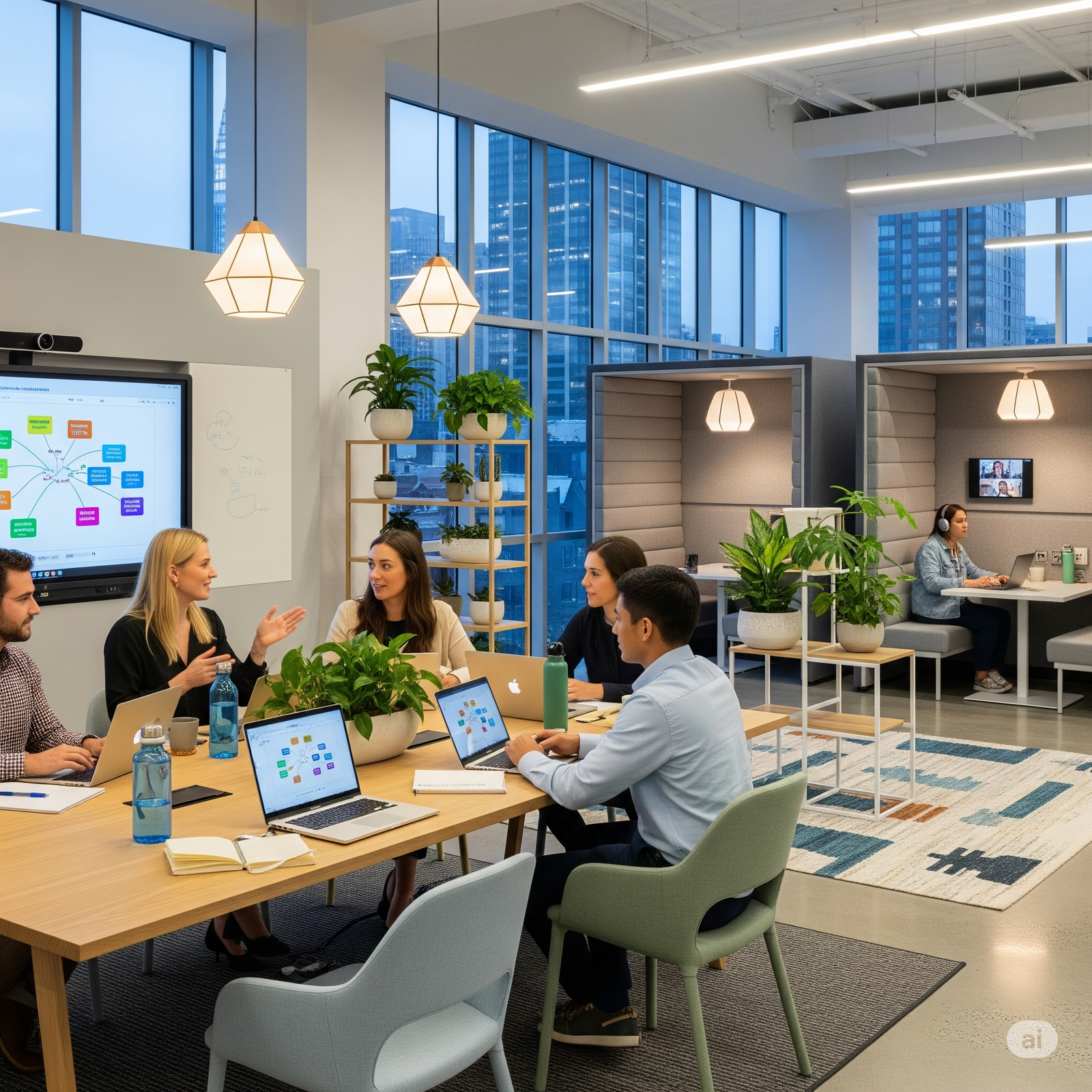
CEOs are redesigning spaces with:
- Flexible seating and team pods
- On-site collaboration tech for hybrid meetings
- Social and creative zones to make commutes worthwhile
As Cisco’s report puts it: “Leaders must make the office a place employees want to be, not a place they have to be.”
Execution Checklist for CEOs in 2025
To succeed with Hybrid 2.0:
- Empower team leaders to set flexible schedules.
- Invest in hybrid-friendly tech – video conferencing, digital whiteboards, collaboration tools.
- Redesign spaces for purposeful in-person engagement.
- Track outcomes, not attendance.
- Communicate openly with employees about expectations and metrics.
Final Thoughts
Hybrid 2.0 is more than a trend—it’s a strategic framework for high-performance organizations in a post-pandemic, digitally connected world. CEOs who see flexibility as a lever for innovation, rather than a concession, will be the ones attracting top talent and outpacing competitors in 2025 and beyond.
References: